Projects
m.connect
Moray & Speyside, Scotland

How We Supported Moray Council’s m.connect Grow Rural Bus Use in Moray
What We’re Delivering
The Challenge
Moray Council and HITRANS – a multi-partner public body responsible for co-ordinating and investing in regional transport infrastructure across a large, dispersed rural area – needed to launch a new rural electric bus service and, over time, extend it across an increasingly wide patchwork of communities: from Buckie, Keith and Elgin to the wider Speyside and Moray-wide network. Each phase of investment (new routes, new zones, and later a real-time Bus Route Tracker as part of the Council’s wider “Bus Revolution” infrastructure programme) needed to be introduced with genuine confidence, not just awareness – across strikingly different audiences: families, commuters, older residents, elected members and community stakeholders, and, hardest of all, young people who don’t traditionally engage with public transport.
As a public body investing significant funds in shared infrastructure and connectivity, Moray Council and HITRANS also carried a responsibility to invest well – for elected members and residents, ensuring their understanding of and support for the initiative and to make a complex, evolving service easy to grasp at a glance. The brand also had to sit comfortably within the Council and HITRANS’ own guidelines, perform across a demanding mix of touchpoints – radio, press, digital, vehicle livery and formal stakeholder briefings – and sustain that confidence well beyond a single launch moment, as new zones, service types and audience segments were added in the years that followed.

Our Approach
Our delivery approach follows the same disciplined, phased pattern on every m.connect commission – so that insight gathered in one phase shapes the messaging, content and stakeholder work that follows it:
Insight & Review
In 2019, Flourish won a competitive tender to build m.connect from the ground up: name, logo, colour palette, tone of voice and photography style, shaped by a full stakeholder and consumer consultation. Every subsequent phase of investment – new zones, new services, the 2026 Bus Route Tracker – has started the same way: reviewing what exists, and identifying what a specific audience needs to understand before we design a single asset.

Audience & Messaging Framework
We designed the brand to flex – resonating with local communities while integrating cleanly into the Council and HITRANS’ own visual identity – and built a messaging hierarchy that runs from the Council’s overarching “Bus Revolution” infrastructure narrative down to individual service and audience messages (on-demand vs. timetabled; 13-25s vs. 41-64+; elected members vs. residents).
Multi-Channel Content & Connectivity Communication
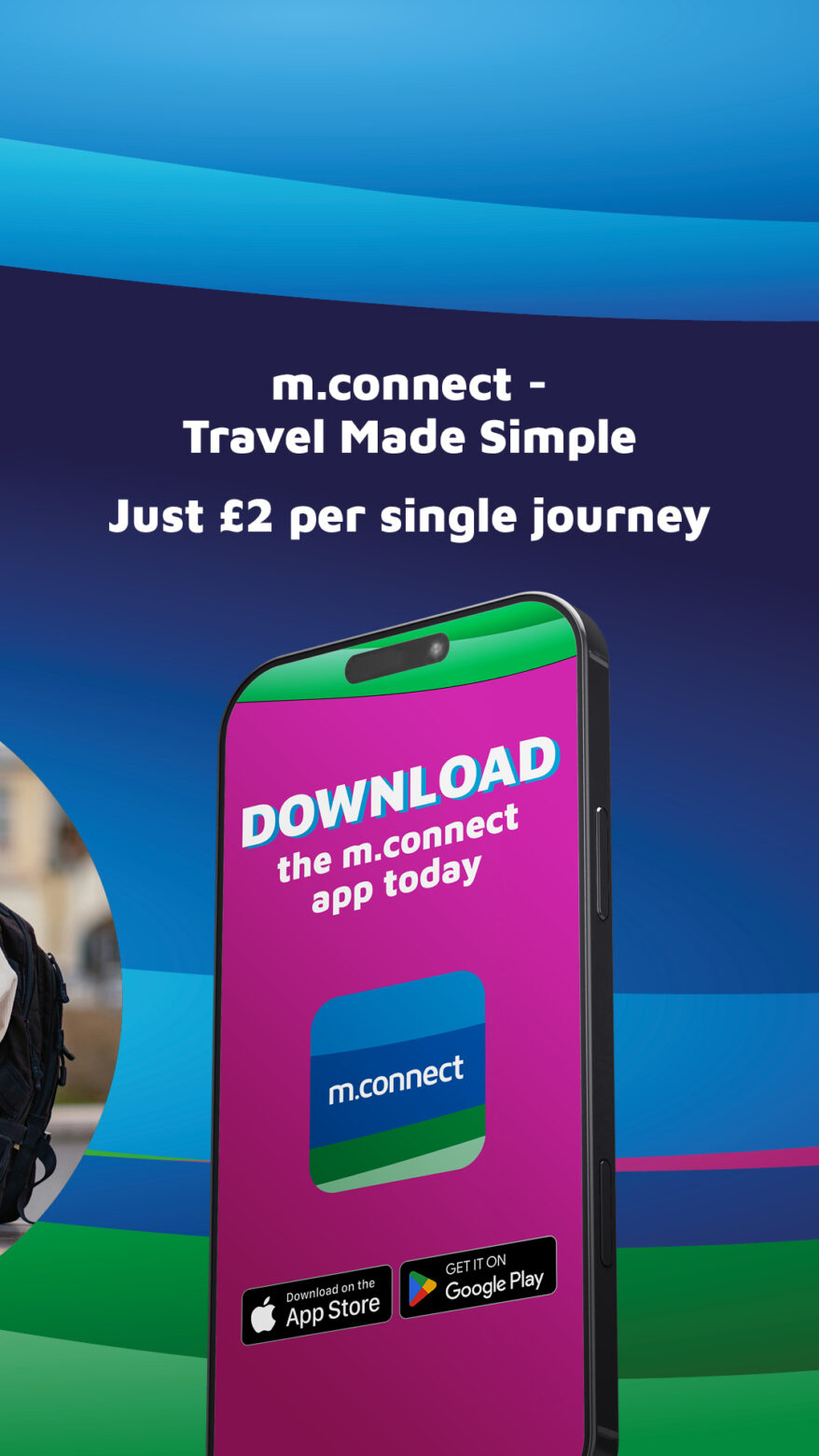
We deliver an integrated ATL, BTL and digital campaign – media planning and buying, creative development, vehicle livery, social content, photography and videography – translating a genuinely complex proposition (routes, zones, live vehicle tracking, journey planning) into materials and in-app tools that make connectivity easy to understand at a glance.
Stakeholder Testing, Confidence & Activation
As m.connect has grown, we’ve continued to run insight-led paid social campaigns across Meta and Snapchat, testing message and creative variance by audience and letting platform data – not assumption – decide what runs next. For major service changes, that same test-and-refine discipline extends into formal stakeholder consultation before public activation (detailed below).
Public Affairs, Confidence & Countering Misconceptions
Every major service change is treated as a public confidence exercise, not just a media buy. For the August 2026 launch of the Bus Route Tracker – a significant infrastructure and connectivity upgrade providing live vehicle tracking, journey planning and accessibility information across the fixed-route network – we worked with Moray Council to develop a formal, tiered stakeholder engagement pack, segmented for the audiences who each needed something different from it:

- Elected members, briefed with the lines needed to answer constituent enquiries and to position the launch as continued Council investment in accessible, reliable public transport.
- Community Councils, equipped to cascade launch information locally and flag the benefits for rural communities, older residents and infrequent users.
- Customer service teams, given a structured FAQ so day-one queries could be answered consistently.
- Residents and the wider public, reached through a dedicated Myth vs Fact document, built specifically to pre-empt confusion and counter misconceptions about what was and wasn’t changing before those doubts could take hold.
This consultation-led approach – key messages agreed centrally, then adapted by audience, with a specific tool built to build confidence and defuse misinformation around a new infrastructure proposition – sits at the core of how we’d approach any major public-body investment communication: aligning partners, informing stakeholders, and only then activating public-facing campaign activity once that foundation is in place

The Result
Five years into the partnership, m.connect is a recognisable, trusted part of the Moray transport landscape – and recent campaign data shows a service still growing in relevance and reach.
2.02 million
ad impressions delivered across Meta and Snapchat during the 8-week summer Moray-wide campaign, generating 19,414 clicks through to m.connect at a cost-per-click of just £0.14-£0.18.
5.05%
click-through rate on the best-performing format (Meta timetable video, at £0.08 per click) – with timetable messaging outperforming on-demand messaging on every format tested, across both platforms.
+12.5% to +20%
year-on-year growth in booking requests (Feb and Mar 2026 respectively), alongside a 25% rise in app downloads and a 50% increase in new registered users.
Up to +900%
year-on-year growth in youth usage of specific DRT and timetabled services – the historically hardest audience to shift onto public transport – with timetabled youth usage up by an average of 670% across the summer 2026 campaign.
£0.07
cost per landing page view on Snapchat, reaching 1.53 million impressions among 13-25 year olds and proving that well-targeted awareness activity translates into real service uptake, not just impressions.